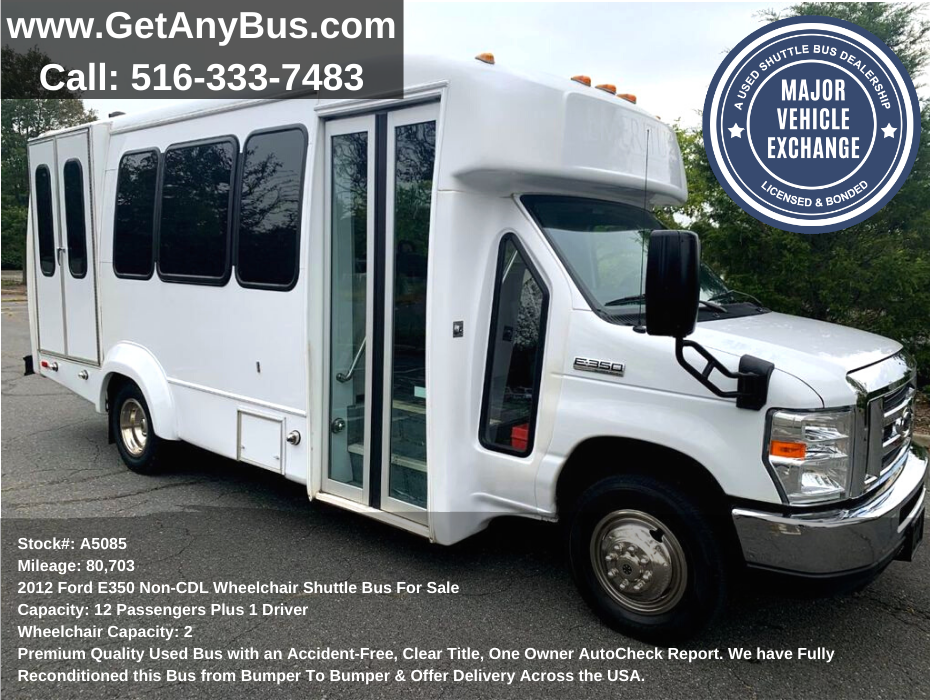
A shuttle bus for sale is a vehicle that typically is used to transport people between two fixed points for short and medium distance trips usually spanning less than an hour. These buses are relatively small in size yet able to accommodate groups of people and they are used for picking up and dropping off passengers either from place to place or to destinations or terminals for other modes of transportation. Due to their less turning radius, they can easily maneuver through busy traffic, narrow streets, and locations not accessible by other larger vehicles. There are two types of shuttle buses namely mini and medium-sized. The minibus is usually defined as seating up to 15 passengers and does not require a commercial license in most instances, whereas the medium-sized shuttle is capable of accommodating 16 to 29 passengers or more and requires a commercial driver’s license with a passenger endorsement. Both can be either equipped with diesel or gas engines, but most buyers prefer gasoline since they are easier to maintain, emit fewer pollutants, and are the dominant engine type in North America. Shuttles are commonly used for passenger interconnections in both towns and cities as well as in suburban venues.

There are several ways a shuttle bus can be used:
1. Jitney Bus Service: The shuttle for sale can be used to transport a small or large number of people directly between urban areas to suburban regions for a fee. Such services are frequently referred to as a Jitney Bus or Dollar Ride service because the riders have to pay a fixed amount to reach their destination. They are also used to transport people directly from suburban areas to the large population and business centers in the city.
2. Park and Ride Service: These services are generally offered by transportation operators and businesses because they do not have sufficient parking space to accommodate the vehicles of every person or employee. The members or employees are picked up or drive to drive from their homes to the parking lots nearest to their office train, intercity bus, or church. A shuttle bus waiting at the parking lot picks and drops them off to their office location or church and vice versa by the end of the day. These shuttle services provide great relief to churches who have problems managing the number of cars parked outside their premises. In order to keep their membership growing many churches are forced to offer this type of transportation to their congregation.
3. Feeder Bus Service: These services are offered by private transportation operators to people residing in a particular neighborhood where the shuttle bus picks them up at a predetermined time and drops them off to the nearest railway stations, airport, sea transit or intercity bus station. This service is widely used by people living in suburban regions who have to travel daily to their respective places of employment (POE) in business and population centers across the city OR they are used in places that are far away from other modes of transportation. The same service is repeated in the evening to get people back to their homes from the airport, railway or bus station.
4. Airport Shuttle Service: This service is similar to Feeder Bus Service and is dedicated to pick up and drop off passengers to and from the airport. Most hotels and motels are located within a distance of 2 miles of the airport and many offer around the clock airport shuttle services to all terminals for their guests every 10 to 15 minutes from the airport terminal to the motel or hotel’s lobby and vice versa. The transportation is often complementary and does not require advance reservations. However, other hotels and venues situated at more distant locations may offer shuttle service less frequently and require advance reservations as well. Sometimes these airport shuttles are also used to transport people within the airport from one terminal to another. Since the distance is short, these buses often have less sitting space and more standing space to accommodate the maximum number of passengers along with their luggage positioned on luggage racks.

5. Shopping Mall Shuttle Service: This service is offered by shopping malls on a daily, weekly, or occasional basis where the bus picks up people at a certain location or locations and drops them at the mall at a predetermined schedule. During holidays and other sale periods, this service helps the mall make more sales and also offers added convenience for the needs of the customers. Similarly, this service is sometimes offered by movie theatres and casinos. Any business that is frequented by customers on a daily, weekly, or occasional basis can offer this service to their customers to make it easier for them to travel to the business, thus easing the burdens of customers and generating more revenue than average.
6. Rail Replacement Bus Service: This service is offered by railway companies to provide an alternate mode of transportation for railway passengers during pre-planned maintenance of tracks or other planned closures. They even cover unplanned closures such as derailments.
7. Church Bus Ministry Service: The Bible suggests every church to reach out to people especially those in need whenever possible. Churches do this by offering pickup and drop off services to their congregation with the help of a Church Bus. These are often small buses capable of seating up to 25 passengers and navigating the narrow streets in almost any neighborhood, usually within a distance of one hour from the Church. Their bus service is offered on Sundays but the vehicle is also used for other activities like religious school, retreats, special events, mission trips, youth camps, community kitchens, etc.

Buses v/s Cars: How safe is a shuttle bus?
Recent research and studies have found that traveling by bus is far safer than traveling by car not only for those occupying the vehicle but also for cyclists and pedestrians. This research conducted in Montreal, Canada found that car occupants were 15 times more likely to get injured than bus occupants, and several pedestrians and cyclists (up to 95%) were injured by cars rather than buses. The study also found that buses did not cause the death of any cyclists but were related to 4 pedestrian deaths. On the other hand, motor cars caused the deaths of 3 cyclists and 42 pedestrians in a single year. Considering these facts and figures, it will be safe to say that traveling by bus is safer than traveling by car.
Buses v/s Vans: Is a 15 seat shuttle bus safer than a 15 passenger van or vice versa?
Shuttle-Bus-For-SalePassenger vans came into widespread use during the late 1960’s when there was a sharp rise in the number of churches that began providing additional services across the United States. With the rise in the number of churches came the demand for transporting both small and large groups for people easily and efficiently. This demand was typically fulfilled by passenger vans and they have been used for transporting church congregations and by schools ever since. Passenger vans however come with known comfort and safety issues.

1. Their extended length and height make them an inherent safety issue.
2. Passengers do not have sufficient space to stand up inside a van.
3. The van usually has bench seats and a very narrow right side aisle.
4. Vans DO NOT have dual rear wheels, which makes them highly unstable during reflex traffic maneuvers.
5. NOT having dual rear wheels creates a higher center of gravity which causes rollover and tire blowouts making them highly unstable and unsafe for public transportation.
6. As a precautionary measure, a van should not seat more than 10 passengers. That means 3 vans will be required to transport 30 passengers.
7. Vans have a high entry point which is highly uncomfortable for senior passengers.
8. The Federal law prohibits the sale of large vans to schools.

15 passenger Van AccidentIn 2005, the National Highway and Traffic Safety Administration (NHTSA) had found that the rollover risk of a van increases by 35% when it is carrying 10 to 15 passengers, and this risk increases by up to 70% when it’s loaded with 16+ passengers. This was their 3rd advisory in the past 4 years and it also claimed that between 1990 and 2003 more than 400 people had lost their lives due to rollover accidents and hundreds of others have been seriously injured. Be sure to visit their website http://www.nhtsa.gov
After the 3rd advisory was released, several insurance companies stepped in and refused to carry insurance on van purchases for the future and simply raised premiums OR canceled them on existing vans. This led to the van owners selling their 15 passenger vans and replacing them with a 15 passenger shuttle bus for sale. The demand for shuttle buses has been on the rise ever since.
Benefits of buying a 15 passenger shuttle bus over 15 passenger vans:
1. A shuttle bus for sale is built on a cutaway van chassis.
2. Manufacturers like Ford, Chevrolet, and others take the van chassis and build the shuttle bus on top of it.
3. Different manufacturers have their own unique style of building the bus but they have to meet quality and safety standards to sell their vehicles to the public.
4. They have dual rear wheels which make it more stable with a wider base to keep the vehicle steadier and create a lower center of gravity making 15 passenger buses much safer than 15 passenger vans.
5. Steel cage construction on the sidewalls and lower center of gravity are two important facets of shuttle bus construction.
6. Riders are more comfortable with standard individual bucket seats, center aisle, and sufficient space to be able to stand up.
7. Because of their dual rear wheels and better load dynamics, there is less likelihood of rollover or tire blowouts which makes them far safer than vans.
8. They have wheelchair lifts or lower entry points making them easily accessible to senior and disabled passengers. This low entry is achieved by adding entry steps or lowering the floor of the bus which increases its height thus enabling passengers to stand when inside the bus. This additional height is complemented by the roof hatches, escape windows, rear doors, and the dual rear wheels keeping the vehicle and passengers safer.

Comfort and Fuel Economy in Buses, Cars, and Vans
A medium-sized shuttle bus for sale with 25 passengers will deliver up to 12 miles per gallon. It will typically consume just 10 gallons of fuel to transport the passengers from point A to point B on a 100-mile trip.
Passenger vans cannot offer the same economies or performance because for safety reasons they should not be loaded with more than 10 passengers, thus requiring multiple vehicles to make the trip. That means 3 vans will be required to ferry 25 passengers and even if the vans offer similar fuel economy to that of a mid-sized shuttle bus, the 3 vehicles may consume 30 gallons of fuel to travel the same distance of 100 miles. Moreover, maintaining and managing one vehicle is better than three considering the cost of driver fees, insurance, repairs, parking, fuel, etc.
The same is the story with cars. A car or SUV can carry up to 7 passengers. So, 4-6 cars will be required to transport 25 passengers. Each car will need a dedicated driver. Even if the car delivers 20 miles per gallon they will consume 5 gallons each to travel a distance of 100 miles, the 6 cars will consume 30 gallons of fuel.
Looking at the above numbers a shuttle bus for sale is obviously the best choice to transport 25 passengers at the lowest price. Furthermore, the passengers are able to stand up, move around the bus, spread their legs, or even recline back on their seats (with optional seating), and enjoy the journey by looking out of the large tinted windows. Such comfort is not offered by cars or vans.
Buses with diesel engines will offer better fuel economy than gasoline engines at 12-15 miles per gallon, so to transport 25 passengers over a distance of 100 miles, they may consume roughly about 8 gallons of fuel.

Shuttle Buses equipped with a Wheelchair Lift
When some of the passengers are seniors, physically disabled, or those requiring wheelchairs, then transporting them requires a specially equipped bus that can move them in and out safely. This equipment is very important for wheelchair-bound passengers for obvious reasons. To fulfill this demand, manufacturers have designed their buses with high capacity wheelchair lifts on their buses that typically can handle weights of up to 800 lbs. The senior or disabled passenger attendant has to position their passenger on the lift and get them lifted inside the bus with the press of a button. Once inside, the bus is equipped with automatic wheelchair tie-downs that will secure the wheelchairs in a fixed position and prevent them from rolling around the passenger cabin while taking their ride. A wheelchair lift-equipped shuttle bus for sale can normally accommodate up to 2 – 5 wheelchair positions. But what if there are 3+ wheelchair passengers? To overcome this problem manufacturers install double flip seats inside their buses so the number of wheelchairs and regular seats can be adjusted on-demand. Wheelchair buses can now accommodate up to 6 wheelchairs with the additional attendant or passenger seats depending on the overall size of the bus.

Wheelchair buses v/s Wheelchair vans
What if a family wants to buy a wheelchair vehicle for one of its disabled members? They can opt to buy a wheelchair van or wheelchair accessible car rather than an entire bus. These para-transit vans for sale are capable of accommodating up to three wheelchair positions and still have space for up to 4 attendants or passengers. The wheelchair lift is either situated at the side of the van or at the rear end. They have automatic tie-downs and flip seats too. Another person can help the disabled passenger get into the van or the handicapped person can wheel themselves in with the help of the control panels situated at the entry door. The side entry handicap vans are more common than rear entry vans because it lets the disabled passenger get to the front seat easily. Rollover safety is not a concern because as a design feature these disability vans always seat less than 10 people on the same chassis as a 15 seater van. They even have a high top roof and often a low floor to let passengers stand up inside the van.
For more information on the above shuttle bus for sale or to check out the large stock of fully reconditioned used shuttle buses and wheelchair vans in our inventory visit our website and call the CEO, Charles Kaufman at 516-333-7483 today!
https://getanybus.com/Shuttle-Bus-For-Sale/
Shuttle Bus For Sale, Shuttle Buses, minibus, 15 passenger bus, 16 to 29 passenger bus, commercial bus for sale, diesel bus for sale, gas bus for sale, gasoline bus for sale, Jitney Bus for sale, shuttle for sale, Dollar Ride bus for sale, church bus for sale, shuttle bus, Feeder Bus for sale, airport bus for sale, Airport Shuttle bus for sale, hotel bus for sale, motel bus for sale, Shopping Mall Shuttle bus for sale, casino bus for sale, Church Ministry Bus For Sale, Ministry Bus For Sale, small buses for sale, 25 passenger bus for sale, school bus for sale, camping bus for sale, 15 seater shuttle bus for sale, 10 to 15 passenger bus for sale, 16+ passenger bus for sale, 15 passenger shuttle bus for sale, shuttle buses for sale, 15 passenger shuttle bus for sale, cutaway bus for sale, Ford bus for sale, Chevrolet bus for sale, 15 passenger buses for sale, mid-sized shuttle bus for sale, Buses equipped with a Wheelchair Lift For Sale, specially equipped bus for sale, senior bus for sale, disabled bus for sale, passenger bus for sale, wheelchair lift-equipped shuttle bus for sale, wheelchair passenger bus for sale, Wheelchair buses for sale, para-transit bus for sale, wheelchair lift bus for sale, handicap bus for sale, disabled bus for sale, 15 seater bus for sale, used shuttle buses for sale
#Shuttle #Bus #ForSale #ShuttleBuses #minibus #passenger #buses #passengerbus #commercialbus #sales #diesel #gas #gasoline #Jitney #Dollar #church #Feeder #airport #Shuttlebus #hotel #motel #Shopping #Mall #casino #Ministry #small #school #camp #seat #cutaway #Ford #Chevrolet #midsized #Wheelchair #Lift #senior #disable #liftequipped #paratransit #wheelchairlift #handicapbus #disabledbus #used #sales